August 22, 2026 · Joy
One execution layer for Codex, Claude Code, Gemini, and OpenCode
People do not run one coding agent anymore. They run Codex on one lane, Claude Code on another, Gemini in a third window, OpenCode when they want a different harness — sometimes in the same afternoon.
Each tool wants to own the terminal. None of them owns execution state across the set.
So you get N disposable runtimes, N copies of context, N ways to lose a crash.
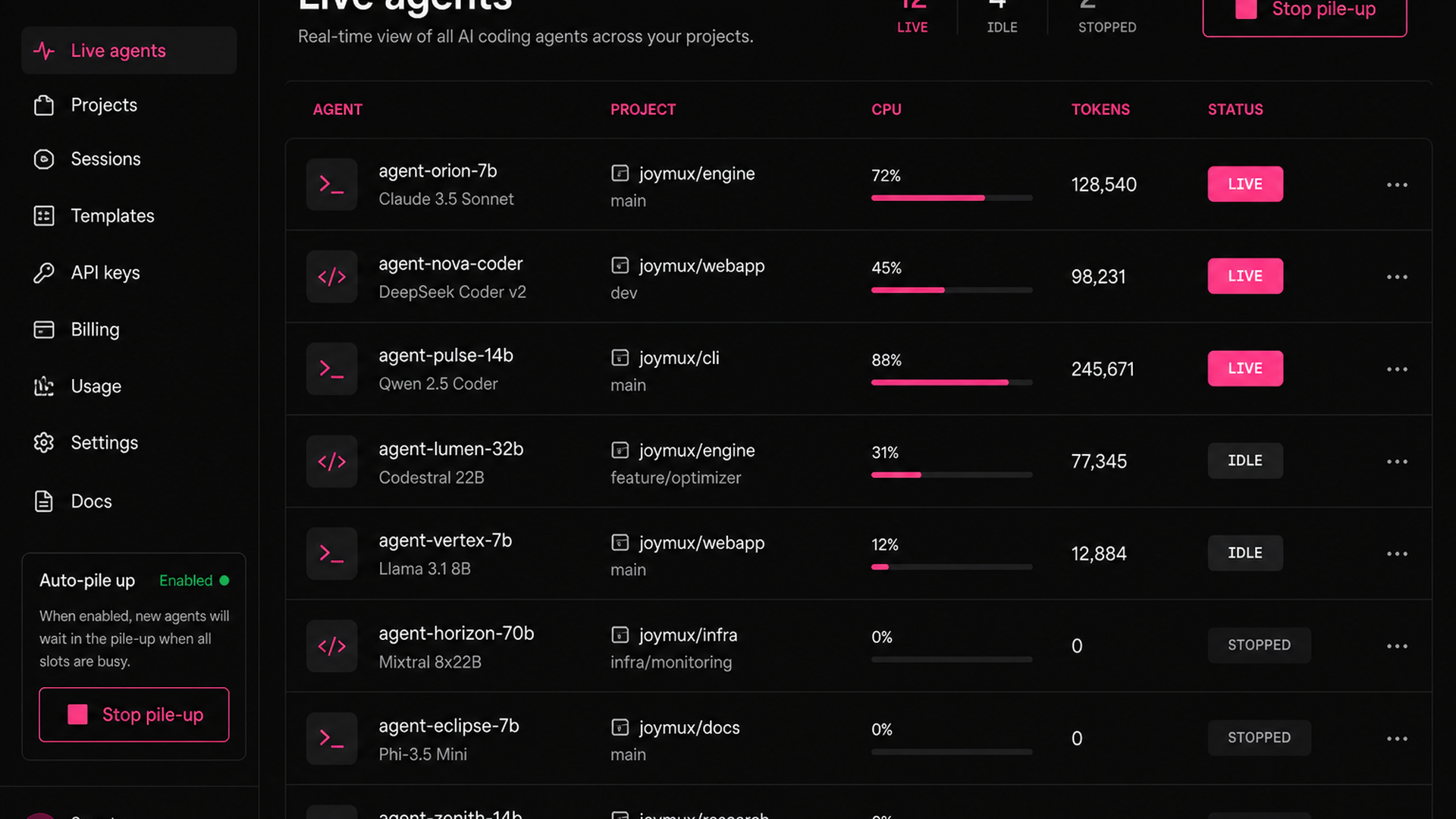
One local execution record. Separate sessions. Switch harnesses without starting over.
The execution record, not the agent
JoyMux is not trying to replace your harness. It is the shared execution layer underneath.
- Persistent sessions that survive the terminal
- Replay and resumable reads
- Bounded context views (deltas)
- Recovery to the same state without a full re-run
Your agent can change. Your execution state stays.
Guarantee: change coding agents without throwing away the execution state they need. Codex, Claude Code, Gemini, OpenCode, and others can come and go. The machine is not starting from zero every time you switch.
What this is not
Not a new chat. Not a new IDE. Not “pick a winner” among models.
If you already live in several harnesses, you need one place where runs are durable — or you will keep paying the tax of disconnected terminals.
JoyMux Pro: 14-day free trial, then $29/month. Cancel anytime. Start trial.
Read next
- Why JoyMux exists
- Disposable terminals are a bad runtime for AI coding agents
- Docs if you want install and session lifecycle